Sustainable Travel Leave
An ultra-low-cost, easy-to-implement initiative delivering higher productivity,⁽¹⁾ improved staff wellbeing,⁽²⁾⁽³⁾ stronger recruitment,⁽⁴⁾ and substantial carbon reductions.⁽⁵⁾
-
Sustainable Travel Leave (STL) is a practical workplace policy that enables staff to travel more sustainably for long-distance trips.
The principle is straightforward. A London–Berlin rail journey cuts emissions by roughly 92 percent but takes seven hours longer than flying. Through Sustainable Travel Leave, the additional travel time is covered by a modest leave allowance.
It can be applied to leisure travel or business travel, supporting carbon reduction commitments while improving fairness and access to low-carbon travel.
-
This simple, ultra low-cost initiative is quick and easy to implement, and offers substantial benefits to employers and employees alike.
We’ve already supported ~200 employers to adopt Sustainable Travel Leave. Employees can make lower-carbon choices; employers face minimal disruption.
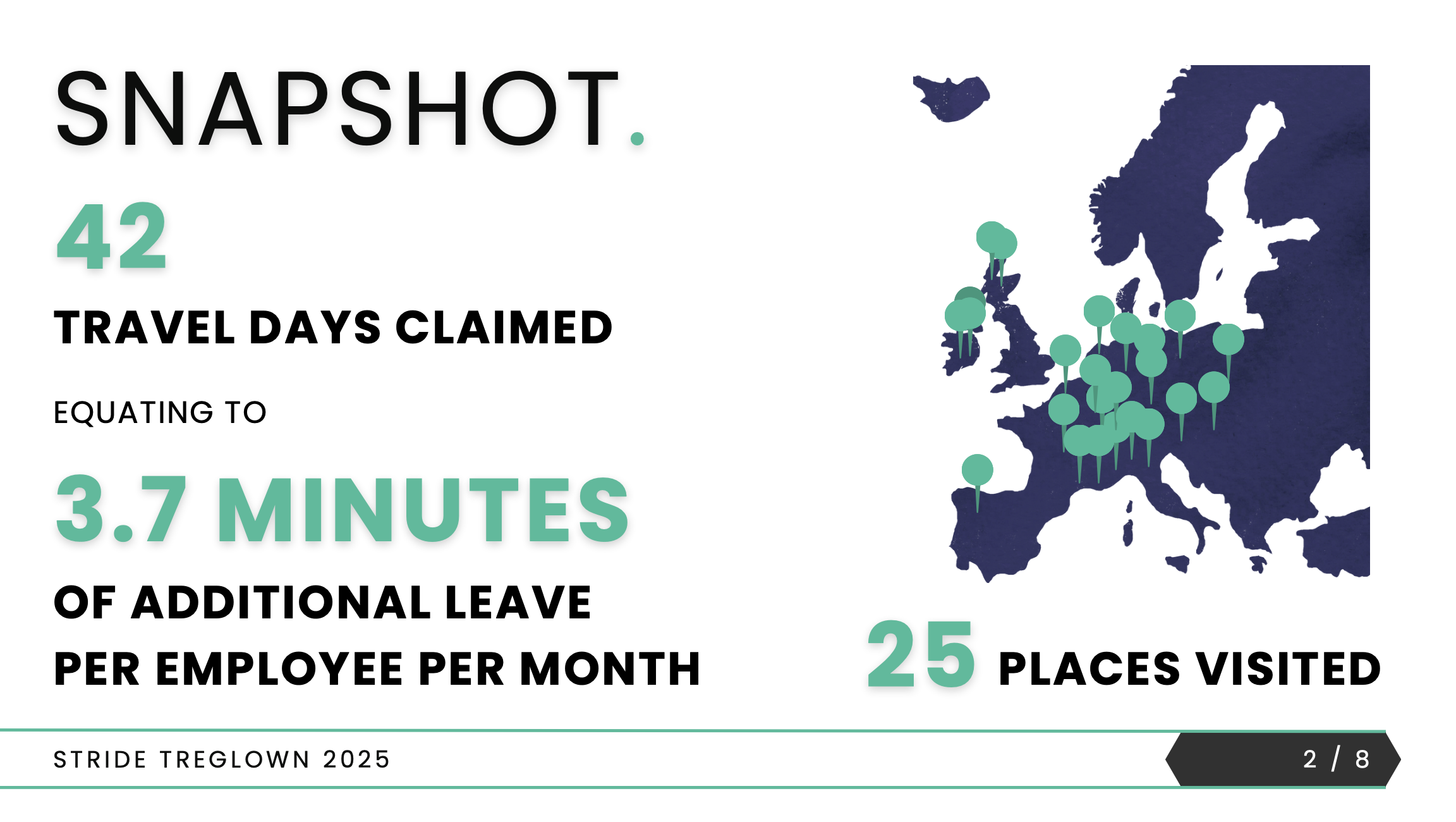
The extra time taken for sustainable travel typically equates to just three minutes per employee per month, yet accredited employers report measurable gains:
74 percent say it increases staff motivation and wellbeing.
67 percent say it has aided recruitment efforts.
81 percent say it helps embed sustainability across their operations.
-
Companies can no longer afford to ignore Scope 3 emissions, particularly from business travel, in light of rapidly expanding regulation and commercial expectations.
UK companies meeting size thresholds are already required to report business travel emissions, with wider sustainability reporting and mandatory net-zero planning coming into force from this year and expanding through the rest of the decade.
At the same time, major clients and government contracts increasingly require credible carbon reduction plans, while EU-linked businesses face even stricter rules.
For companies of all sizes, reducing business travel emissions is a simple, practical way to stay compliant, competitive, and credible. And adopting Sustainable Travel Leave for business travel is an ultra-low-cost, easy-to-implement mechanism to achieve this.
-
Implementing Sustainable Travel Leave (STL) is made quick and easy with our free service.
STL can integrate seamlessly into any HR system / processes, and after you’ve had your policy signed off internally, the entire set-up and implementation process can be completed in as little as ten minutes.
We provide everything employers need to offer STL, including:
All of the required policy documents,
employee procedures,
request forms,
other roll-out materials.
We can adapt these to match the existing language and tone used across your organisation’s other policies, and we’ll also help you to launch the policy internally (and externally if desired).
To implement Sustainable Travel Leave at your workplace, please get in touch, or learn more about our service here.
-
Sustainable Travel Leave can cover leisure travel, business travel, or both. Both policies seek to address critical barriers to CO₂ emissions reduction.
Flying is the most polluting thing an individual will do in their life. And as an industry, commercial aviation is one of the largest and fastest growing contributors to climate change.⁽⁴⁾
We know that people want to fly less. Research conducted in 2020 with over 30,000 participants revealed that 67% of UK flyers said they wanted to take fewer flights in the future to help combat climate change.
But: Travelling by land or sea often takes longer than flying, meaning that those who do want to avoid flying/want to fly less must sacrifice more of their time to make the eco-friendlier choice. This is a key barrier preventing even highly motivated individuals from flying less.
Business travel is a major driver of Scope 3 emissions increases.⁽⁶⁾ Addressing this issue can be a quick and substantial win for companies looking to reduce their carbon footprint.

Implement Sustainable Travel Leave with our free policy templates and ongoing support for your HR Team.
As seen in…















Latest news