

Environmental impact
Sustainable Travel Leave is a high-impact climate action that directly cuts carbon emissions and helps both individuals and organisations to substantially reduce their impact on the planet.
Why we need to fly less
Flying is one of the most carbon-intensive activities an individual can do in their lifetime. Aviation’s CO₂ emissions have grown rapidly as demand for air travel has expanded, and it is one of the fastest-growing sources of greenhouse gases globally.
Aviation accounts for around 7 percent of the UK’s CO₂ emissions. This has consistently grown faster than rail, road, or shipping emissions over the past two decades and is projected to reach 16 percent by 2035.⁽¹⁾
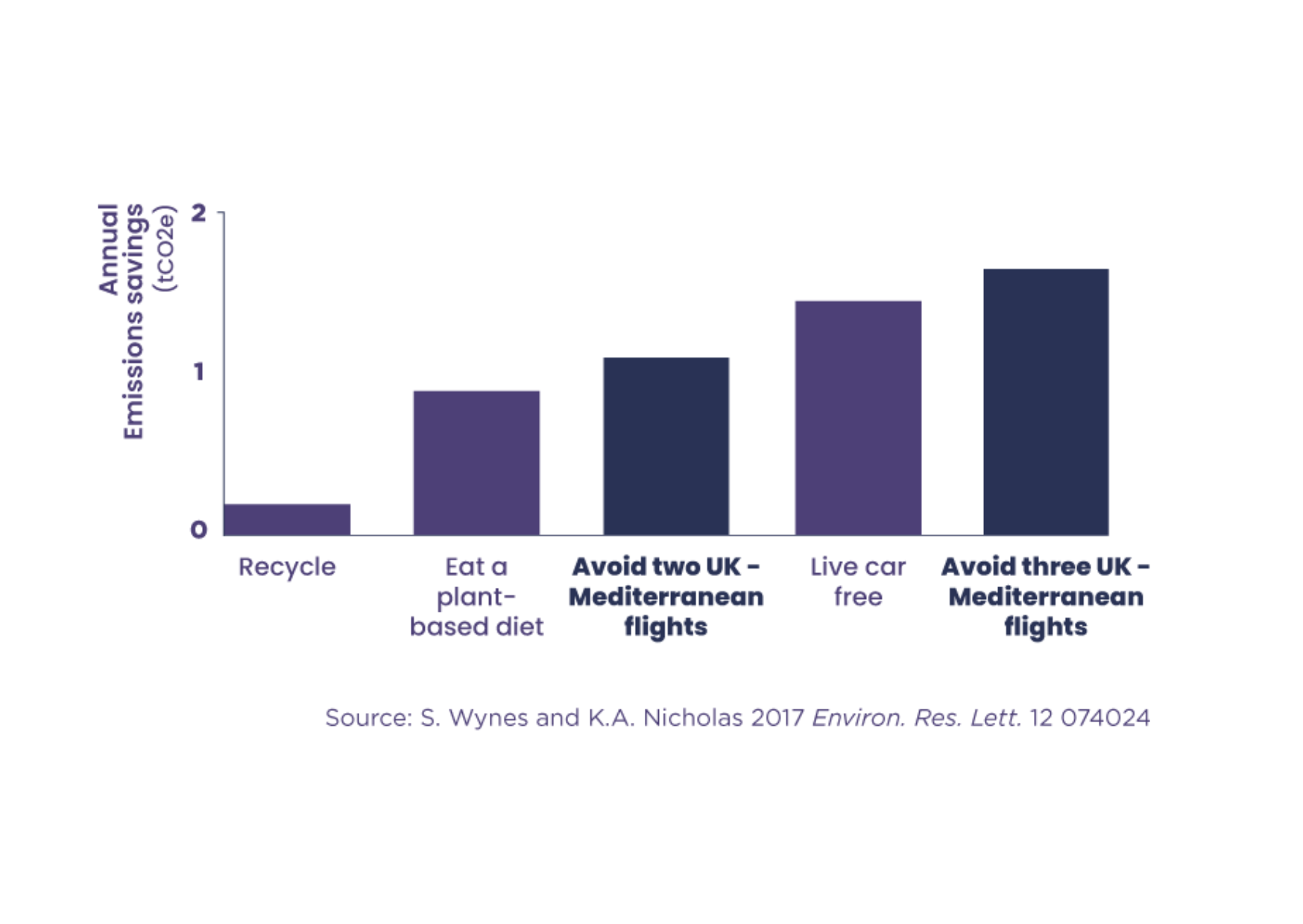
For individuals, flying often dominates personal carbon footprints: a single long-haul flight can emit more CO₂ than many people produce in months of daily living, even before accounting for the additional climate impact of high-altitude emissions.⁽²⁾
In 2018, Brits took more flights than any other nationality.⁽³⁾ For the UK to lead on avoiding the worst effects of climate change, we must get a grip on flying. With technological solutions out of reach for decades to come, that means reducing the amount we fly.
Business travel: a growing source of employer emissions
International business travel is one of the fastest-growing contributors to employer emissions as organisations expand global operations. Many companies find that Scope 3 emissions from staff travel account for a large share of their reported footprint, especially in knowledge and professional services sectors where travel is frequent.⁽⁴⁾
Reducing flying for work is therefore not only an ethical choice but a strategic climate priority for organisations striving to meet net-zero commitments.
How Sustainable Travel Leave cuts carbon
Sustainable Travel Leave enables and supports employees to choose low-carbon travel for work and long-distance trips by giving them dedicated paid time to travel by train or other low-carbon modes of transport. This reduces demand for flights and helps shift travel behaviour at scale.
Switching from flying to taking the train, for example, often results in very large carbon savings:
On many European routes, rail travel can emit over 90 percent less CO₂ than the equivalent flight. For example, a London–Paris train journey produces around 22 kg CO₂ compared with 250 kg by plane — a difference of 92 percent. ⁽⁵⁾
Data from employers who have adopted STL shows that each flight-free journey taken using the scheme saves an average of 444kg of CO₂ - with some journeys saving up to 1,500kg of CO₂.
Shifting norms and fostering long-term change
When organisations embed Sustainable Travel Leave into travel policies:
Employees are more likely to choose rail over flying, especially for journeys under ~6 hours where efficient train alternatives exist.
Travel becomes part of climate strategy, not carbon “business as usual.”
Organisations see lasting reductions in Scope 3 travel emissions, accelerating progress toward net-zero targets.
A straightforward climate-positive policy
Unlike offsets or carbon accounting tricks, Sustainable Travel Leave reduces emissions at the source by enabling real behavioural shifts. Choosing a train over a flight cuts out carbon at the point of travel — and, multiplied across staff and years, leads to measurable climate benefits for organisations and the planet.
References
(3) https://www.liverpool.ac.uk