
How It Works

How it works for leisure travel
➤ After implementing an STL policy with our help, colleagues will be able to access up to two “sustainable travel days” per year (pro rata for part-time staff).
➤ This is time that can be claimed by staff using flight-free travel to cover the extra time required for slower, low-carbon long distance journeys.
Sustainable travel time claimed typically equates to just three minutes per employee per month.
-
Lucy wants to travel from London to Berlin without flying.
Lucy calculates how long the journey takes (in this example, nine hours by train).
It would have taken two hours to fly - so it takes seven hours longer to get there without flying.
Lucy decides to take the train, reducing her emissions from the journey by 92 percent!
Lucy is granted an additional seven hours of paid time off work to cover the extra time required for her carbon-saving journey.
How this additional time is granted is at the discretion of the employer - some give it back as annual leave after the trip, some process it as TOIL, and some handle it as they would volunteering leave or other types of paid leave already set up on their HR system.
Our policy templates are designed to be flexible and work seamlessly with any HR system or process already in place.
-
If your organisation already offers paid time off for volunteering, Sustainable Travel Leave can slot into your existing policy.
We do this by expanding the scope of your existing policy to allow colleagues to choose whether they use the time already offered to either volunteer (as per the existing policy) or to reduce emissions by opting for slower, low-carbon travel.
If you don’t currently have paid time off for volunteering but would like to introduce it, we can also help your organisation to introduce a general Supported Leave Policy - encapsulating Sustainable Travel Leave and Volunteering Leave together.
-
1. Attract talented people.
70 percent of under 40s consider environmental policies and benefits before accepting a job (Deloitte). 67 percent of employers who already offer STL say it has aided recruitment efforts.2. Retain talented people.
Staff value working for an organisation that shares their values and supports them to make the choices they want to make. 74 percent of employers who already offer STL say it increases staff motivation and wellbeing.3. Demonstrate climate leadership and enhance company image.
Become an accredited ‘Sustainable Travel Employer’. 96 percent of existing Sustainable Travel Employers say it helps them to demonstrate their climate commitments.4. Unlock additional employee benefits.
Implementing Sustainable Travel Leave unlocks a suite of additional benefits, such as curated discounts on things like UK Railcards and train tickets, free electronics and appliance repairs, discounted e-bike hire and more.5. Very low operational burden.
Seamlessly integrates into any HR system. Ongoing support from Possible and the small number of staff who claim sustainable travel leave means administration is simple and predictable, with minimal impact on staffing or rotas.6. Positive cultural signal without mandating behaviour.
Encourages low-carbon choices while remaining fully voluntary, helping to build a sustainability-aware culture organically rather than by enforcement.7. Supports fairness and accessibility.
By compensating some of the extra time required for rail/ferry travel, the policy prevents sustainable choices from being available only to those who can afford more days off, and also addresses the fact that in most organisations, low-carbon travel choices are effectively penalised.8. Organisational discounts.
Unlock access to exclusive discounts on things like team-building workshops, carbon literacy training and workplace sustainability solutions.
How it works for business travel
➤ After implementing a Sustainable Travel policy with our help, colleagues will be able to access up to two “sustainable travel days” per year (pro rata for part-time staff).
➤ This is time that can be claimed by staff using flight-free travel for work to cover half of the extra time required for slower, low-carbon business journeys.
-
Lucy needs to travel from London to Berlin for work, and wants to do so without flying.
Lucy calculates how long the journey takes (in this example, nine hours by train).
It would have taken two hours to fly, so it takes seven hours longer to get there without flying.
Lucy chooses to take the train, thereby reducing the emissions from her journey by 92 percent.
Lucy is granted an additional 3.5 hours of paid time off work to cover half of the extra time required to travel by train.
How this additional time is granted is at the discretion of the employer - some give it back as annual leave after the trip, some process it as TOIL, and some handle it as they would volunteering leave or other types of paid leave already set up on their HR system.
Our policy templates are designed to be flexible and work seamlessly with any HR system or process already in place.
-
1. Substantially reduced emissions (with minimal cost).⁽¹⁾
Switching some work trips from air to rail/ferry drastically cuts emissions - by up to 96% - while requiring only a modest time allowance.2. Higher productivity.⁽²⁾
Employees can better work during rail/ferry journeys, unlike flights where time is lost to airport transfers, security queues, and offline periods.3. Accreditation.
Become an accredited Sustainable Travel Employer.4. Enhanced company profile & talent attraction.⁽³⁾
Purpose-driven policies resonate with candidates, making recruitment easier and improving retention.5. Better staff wellbeing and reduced burnout.⁽⁴⁾
Train and ferry travel is often perceived to be less stressful, and allows for more productive work en route. We also know that 67 percent of UK flyers say they want to fly less; enabling colleagues to live out their values improves wellbeing and motivation.⁽⁵⁾6. Stronger alignment with ESG, net-zero and procurement expectations.
Clients, funders and regulators increasingly expect demonstrable climate action. A clear policy strengthens bids, reporting, and compliance. -
Companies can no longer afford to overlook Scope 3 emissions, particularly from business travel, as regulation, market expectations and commercial risk are rapidly converging.
In the UK, large and mid-sized companies meeting two of the following thresholds — 250+ employees, £36m+ turnover or £80m+ balance sheet — are already in scope for mandatory reporting that includes business travel, with further sustainability reporting requirements coming into force from this year and expanding through 2027 and beyond.
These frameworks don’t just require disclosure, but credible plans to reach net zero, making a sustainable travel policy a straightforward and visible way to evidence action.
At the same time, government contracts and major partners are increasingly mandating carbon reduction plans regardless of company size, while EU-linked operations face even stricter reporting obligations.
For smaller businesses, acting now is about future-proofing, strengthening competitiveness, and becoming a preferred supplier — and reducing employee travel emissions is one of the most practical places to start.
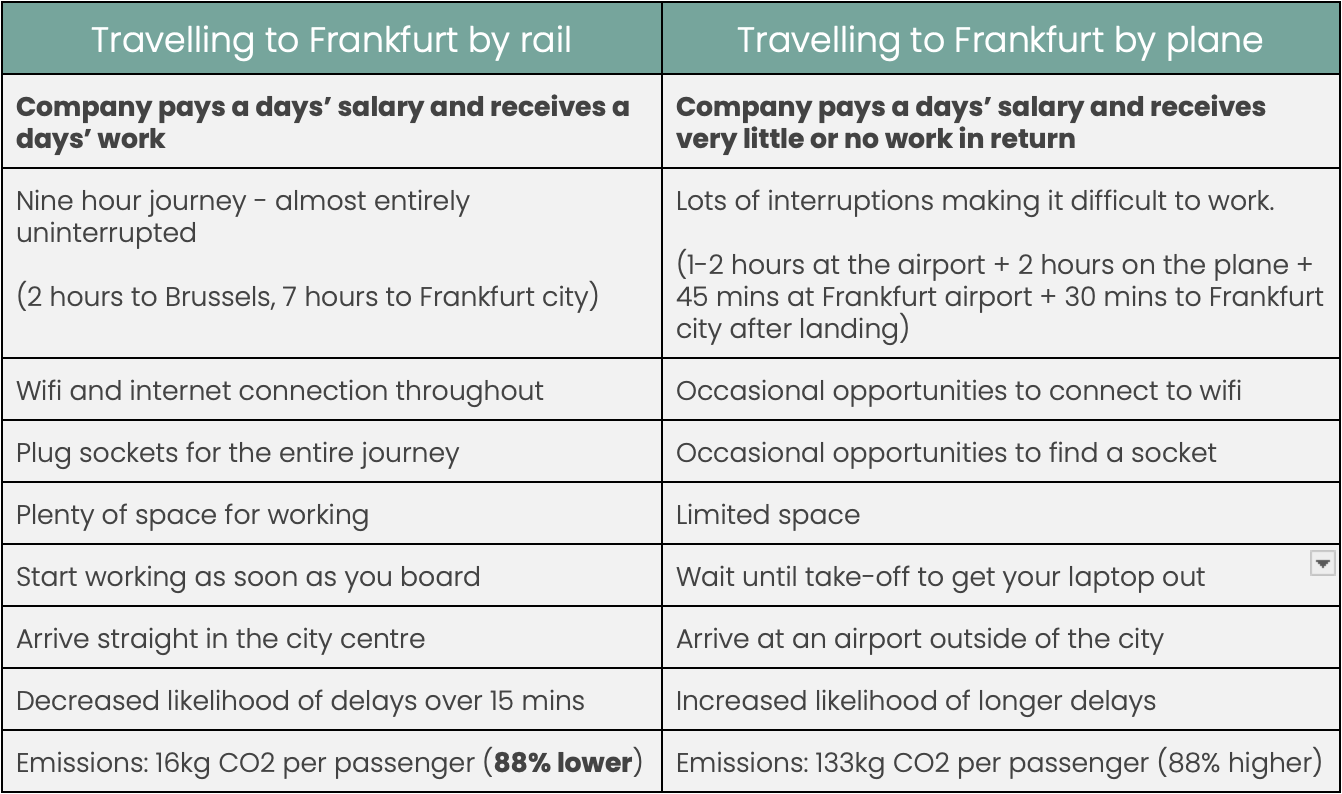
The business travel version works just like the leisure travel version, with the main difference being: for business trips, employees can claim 0.5 hours of paid time off for every additional hour spent on the journey, rather than one hour.
This is because employees are already being paid for the trip itself, and will typically be expected to work on the journey.
As such, the extra time required for the flight-free journey is treated as a partial inconvenience, not full personal time lost.